
JOURNEY INTO
THE
BHAGAVAD GITA
LIVE ONLINE COURSE
A Comprehensive Introduction to the World's Foremost Book of Transcendental Knowledge
8 classes + 2 bonus interactive workshops
with Hari-kirtana das, author of Journey Into the Bhagavad Gita

starting October 2025
Every culture asks the same big question: How should a person live?
From there it unfolds:
Who am I? What is my duty to the world and others? What will truly bring me joy?
If you're asking these questions, you're already halfway home.
Searching for answers to these kinds of questions is an important essential part of being human.
It’s the natural expression of our unique capacity for self-awareness, meaning-making, and transcendence.
Because even in tumultuous times—especially in tumultuous times—we don’t just react to our environment; we reflect on it.
Because mere survival is not enough: we want to understand the significance of our existence.
Because this quest connects us to one another across cultures and eras and, when guided by wisdom, it leads us not only to truth—but to love.
To ignore these questions is to miss the rare opportunity that human life affords.
At some point, we need a guiding light to support our search.
For me, that guiding light is the Bhagavad Gita. And I believe it can be yours, too.
Most of us discover the Bhagavad Gita sooner or later: we hear it mentioned in a yoga class, see a quote on social media, or find it listed as recommended YTT reading.
It’s a central text in yoga, and a touchstone for scholars and seekers. Duty, righteousness, devotion, and the nature of reality—all in one compact conversation, carried forward for centuries.
And yet, many readers hit the same roadblocks:
-
You start and stop because the text feels overwhelming.
-
You grasp parts but sense you've missed the deeper meaning.
-
You’ve want to begin, but the Gita feels intimidating from the first pages.

I’ve been there. The first time I tried to read the Gita, I couldn’t wrap my head around it. The second time, I understood some of it—but couldn’t accept most of it.
Still, I had a feeling that what I was looking for was in these pages, so I came back a third time.
That’s when it clicked.
The fog lifted, and suddenly the verses crystallized with startling clarity. For the first time, the Gita wasn’t just a book. It was a compass for every choice I faced.
The difference was having a teacher—someone to provide the context, translate the Sanskrit into comprehensible English, and show how the ideas come to life in real decisions.
That was over forty years ago. I’ve been studying, practicing, and teaching the Gita ever since.
My book, Journey Into the Bhagavad Gita makes the teachings accessible without dumbing them down.
My LIVE ONLINE course, Journey into the Bhagavad Gita, is a joyful adventure into the many ways you can apply the Gita’s teachings in your daily life
Be one of the first people to know the Fall 2025 dates.
Five modern problems the Gita speaks to
The Gita isn’t theory for a museum. It speaks straight to the pressures of modern life:
- Decision paralysis. The Gita offers a repeatable way to think through problems, find the solution that will serve the greatest good, and take action.
- Reactivity and overload. It offers centering practices and perspectives that help you respond from a higher level and focus on what’s really important.
- Burnout from over‑giving. It offers a service ethic that encourages compassion while honoring limits and releasing attachments to outcomes.
- Polarization and conflict. It offers a lens that dignifies every being and supports firm, humane action.
- Purpose drift. It offers a purpose framework rooted in who you are, not in titles or results.
It's rigorous, comprehensive, non‑sectarian, practical.



This course offers more than garden‑variety insights—it cultivates realization you can live by.
You’ll get:
-
A decision framework you can trust
-
Keys to having steadier mind under stress
-
Values‑aligned action without burnout
-
Secrets to healthier relationships
-
Principles of virtuous leadership
-
Devotion without dogma


Why Study the Gita
Thoughtful people have consistently turned to this book of timeless wisdom. Here are three reasons why:
The Bhagavad-gita is the pre-eminent book of yoga philosophy
If you want to understand the perennial philosophy that connects all of the classical yoga systems, then you want to study the Bhagavad-gita. It presents a worldview of sacred order, methods for self-realization, and a path to transcendence that runs through the world, not away from it.
The Bhagavad-gita is a powerful guide for personal spiritual development
Blending philosophy and theology to take us beyond mental speculation and formulaic religion, the Gita invites us to see our lives in the light of universal truths that shine from beyond the reach of illusion, egoism, attachments, aversions, and fear.
The Bhagavad-gita is a guide to enlightened spiritual activism
The world's problems can't be solved by using the same kind of thinking that created those problems in the first place. At a time of heightened urgency about the state of the world, the Bhagavad-gita offers us a paradigm shift toward clear principles for compassionate, effective action.


COURSE AT A GLANCE
Format
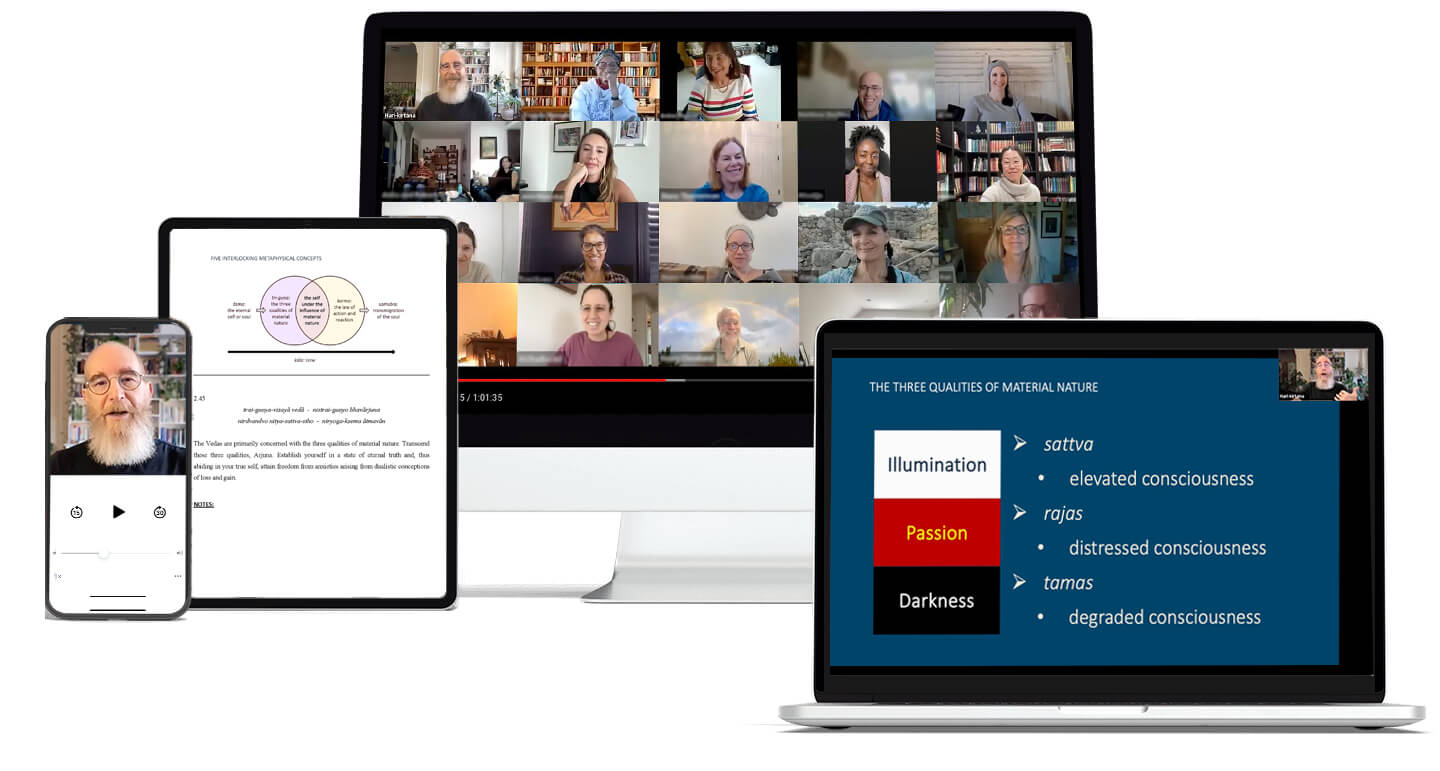
- 8 Live Online Classes
- 90 minutes each
- Attend live or watch on demand
- Replays provided with lifetime access
Schedule
- Classes: Wednesdays, Oct 8, 15, 22, 29; Nov 5, 12, 19, 26; Dec 3, 10 from 7:00–8:30 p.m. ET
- Bonus Workshop Sessions: Wednesday, November 5 and Wednesday November 26 from 7:00–8:00 p.m. ET
Plus:
- Two live interactive workshops
- Worksheets, readings, and exercises to guide your reflections
What We'll Cover
What We'll Cover
Class 1: The Big Picture
An overview of the conversation between Krishna and Arjuna, the significance of the battlefield, the four classical paths of yoga, and how to enter into the Gita’s world.
Class 2: Dharma
The meanings, significance, relevance, and centrality of "dharma" as the Gita’s overarching theme.
Class 3: Philosophical Concepts
Five interlocking ideas about unseen aspects of reality that form the basis of the Gita’s worldview.
Class 4: The Material World
The elements of material existence and the spiritual backdrop of our embodied experience.
BONUS INTERACTIVE WORKSHOP #1
A guided group discussion about the concept of Krishna, how we think about God, and the synthesis of duality and non-duality in the personal form of Absolute Reality.
Class 5: The Gita's Polestar
The central message around which the Gita’s universe revolves.
Class 6: The Dark Side of God
Ethics, theology, revelation, and the problem of evil.
BONUS INTERACTIVE WORKSHOP #2
A guided group discussion about "realized" knowledge, the qualities of the lower self, the attributes of the higher Self, and the nature of the Supreme Self.
Class 7: Discernment
Recognizing the distinction between saintly and demonic mentalities.
Class 8: The Perfection of Yoga
The meaning of “surrender,” the primacy of devotion, and the five levels of secret knowledge.
Enrollment for
Journey Into the Bhagavad Gita
will open again this fall.
Use this form to get on the wait list and be among the first to know about the fall 2025 course offering (including early-bird tuition pricing).

Who This Course is For
It's for you if…
- You’re spiritually curious but wary of dogma
- You practice or teach yoga and want philosophical depth
- You lead, organize, or serve—and want a steadier decision framework
- You’re in burnout or transition
It's probably not a fit if…
- You want quick inspiration without practice
- You’re looking for sectarian apologetics or a debate club


Meet Hari‑kirtana das, Author, Yoga Teacher, and Mentor
I’m Hari-kirtana das, and my mission is to illuminate the enduring relevance of yoga’s ancient wisdom to life in the modern world. I’ve been doing that for nearly 40 years.
In addition to a lifetime of practice, I have an 800-hour yoga teacher certification from the Jivamukti Yoga School. I’m on the faculty of numerous Yoga Teacher Training programs, and I offer live online workshops and courses throughout the year.
I’m also the author of two books on yoga philosophy: Journey Into the Bhagavad Gita: A Guide to Exploring Timeless Principles of Transcendental Knowledge and Integrating Them Into Your Life and In Search of the Highest Truth: Adventures in Yoga Philosophy.
My books are scholar‑endorsed, highly-rated by readers, and used as a keystone text in YTT programs. I'm known for keeping the rigor, losing the jargon, and turning philosophy into practice.
I teach the Gita because it changed how I live, serve, and relate—and I’ve watched it do the same for students from every background. My aim is simple: context, plain language, and practices you can use the same day. I’d be honored to study this text with you.

Let’s study the Gita, pressure‑test it together, and let it refine how we live.
I'll see you in class.
Enrollment for
Journey into the Bhagavad Gita
will open again this fall.
Use this form to get on the wait list and be among the first to know about the fall 2025 course offering (including early-bird tuition pricing).